
Single, but not looking for a fairytale
You want to understand the kind of partnership your chart supports, where a serious connection may begin, and which periods deserve more attention.
There is a lot more your chart can say than “you'll get married at 29.”
Who you may choose. How you may meet. When a relationship becomes more likely to turn serious. What your marriage could actually feel like — and what to know before you get there.
25+ pages, personalised to your exact birth details.
Those are the questions this reading is built around. Not a horoscope. Not a page of vague personality statements — a complete reading of your marriage story as your chart describes it.
Your report looks at marriage from eight different angles.
How strongly partnership is supported, which relationship path appears more likely, and where the chart asks for nuance rather than certainty.
Distinctive patterns in temperament, communication, values, family environment and the kind of work that may suit them.
Friends, work, dating apps, travel, shared interests or family — ranked by where your chart shows the strongest signal.
Meeting, dating, becoming significant, commitment and marriage are separated into distinct windows — because they are different stages.
Romance, communication, intimacy, shared money, conflict, family and ambition — the lived texture of partnership after the wedding.
How partnership may affect career, money, networks, responsibilities and living arrangements — directly or indirectly.
The friction worth understanding early, without turning normal relationship pressure into a prediction of failure.
Where to show up, what to notice, which periods favour which actions, and what conversations may matter early.
The stronger path here isn't a completely formal introduction.
The chart leans towards meeting through friends, networks, learning or shared interests — followed by a connection that grows through consistent communication.
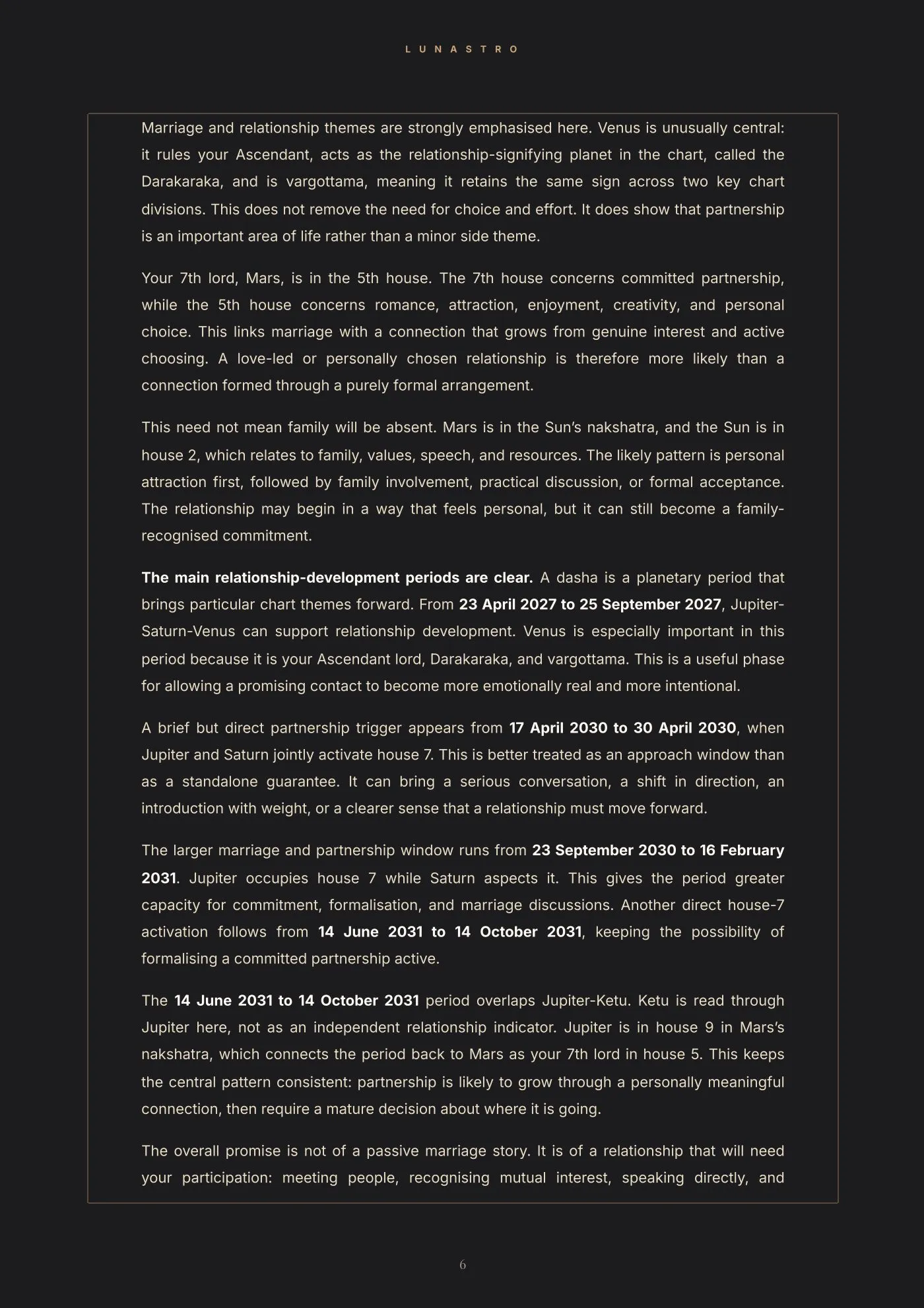
Several earlier periods support meeting and relationship development. The clearest commitment period comes later, when multiple relationship indicators activate together.
So the story isn't “wait until your marriage year.” It's more likely: meet → develop → decide → formalise.
That level of distinction is what you're paying for.
You shouldn't have to accept a prediction because Luna said so. Behind every major interpretation is the reasoning that produced it.
A personally chosen relationship appears more strongly supported than a purely formal arrangement.
The planet governing committed partnership connects strongly with the part of the chart associated with romance, attraction and personal choice.
Natal chart · 7th house and 7th lord · Darakaraka · Vimshottari Dasha · transits · Navamsa (D9) · Jaimini indicators · nakshatras — with the factors that support and contradict each conclusion.
You don't need to know any of these to understand your report. But if you want to know why, the reasoning is there.
You've probably seen astrology like “Venus in Cancer means you marry someone nurturing.” That isn't how Luna reads a chart.
Conclusions are stronger when multiple independent indicators point the same way. Then Luna asks: what survives when we look at all of them together? Sometimes the answer becomes stronger. Sometimes more nuanced. Sometimes Luna will simply tell you “I wouldn't make a strong prediction from this alone” — and that's part of the reading too.
Your chart can suggest patterns, periods and stronger probabilities. It cannot remove human choice. When the evidence is strong, Luna says so. When it's mixed, Luna says that too.
Perspective, not prophecy.
Two people born under the same zodiac sign can have completely different marriage readings. Yours is calculated from your date of birth, exact birth time and place of birth.
Why the birth time? Because even a small change can affect your Lagna, house placements and divisional charts — the very things used to study marriage. The more accurate your details, the more precise the reading.
Your marriage. Here's what's inside.
Plus the astrological reasoning behind the major conclusions.
No subscription. Delivered in the LunaAstro app in about 30 minutes.
Chat with your report in the app to clarify, question or go deeper.
Date, exact time and place of birth. It takes about a minute.
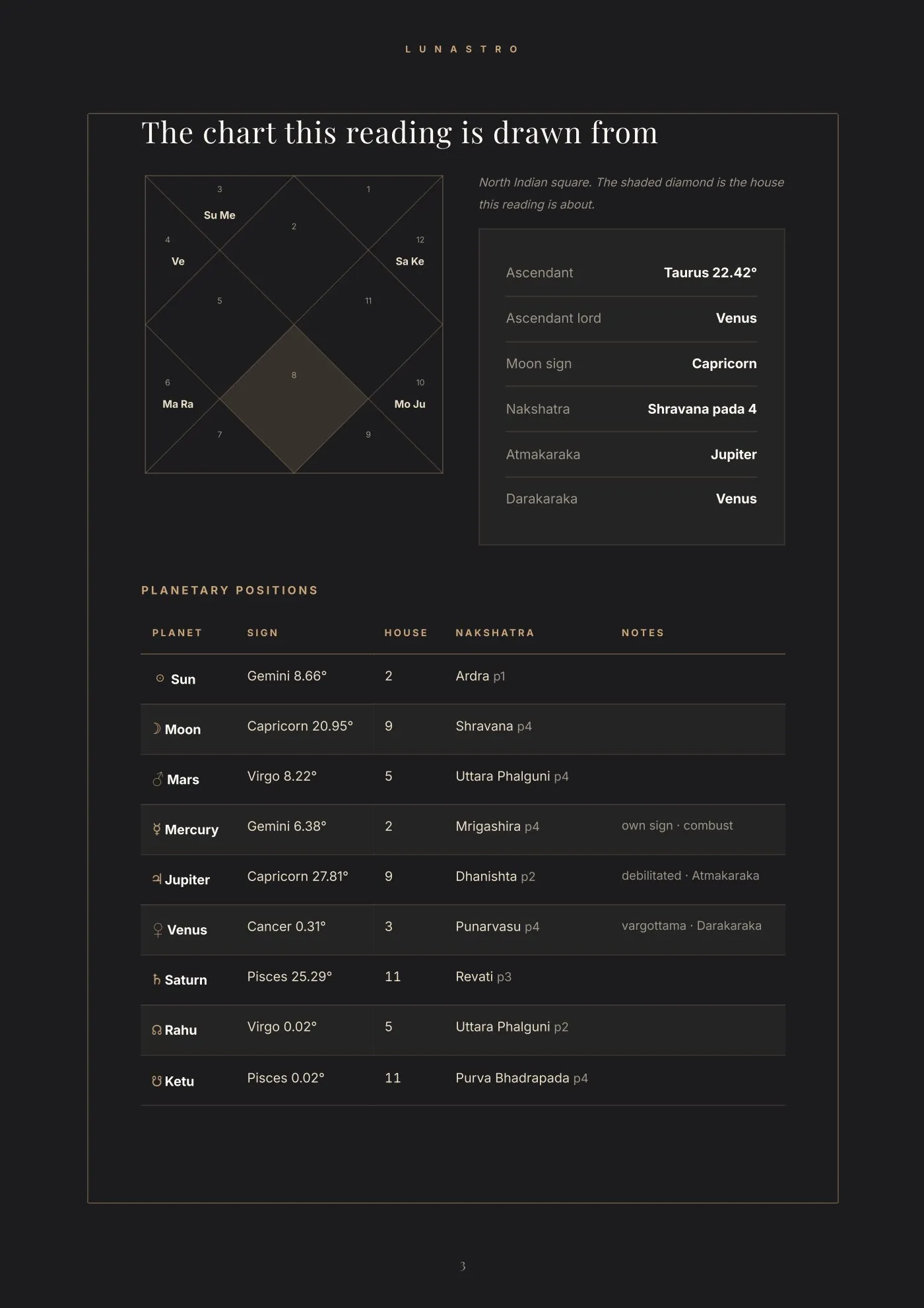
Your natal chart, Navamsa, dashas, transits and supporting indicators are read together—not as isolated placements.
Your personalised report arrives in about 30 minutes. Revisit it anytime and ask up to 10 follow-up questions in the app.
The question changes with your life. The chart reading should too.
You want to understand the kind of partnership your chart supports, where a serious connection may begin, and which periods deserve more attention.
The report does not judge a named partner or replace a real conversation. It helps you understand your own relationship patterns, commitment timing and blind spots.
The reading shifts towards the marriage you are in: how it may settle, what it asks of you, where pressure may build, and which patterns are worth handling consciously.
You can be deeply into Vedic astrology. You can know nothing beyond your zodiac sign. You can be sceptical. The standard is the same:
That's enough.
Your chart shows periods, not appointments. The reading maps the Vimshottari dasha and the Jupiter–Saturn transits over your 7th house to give dated windows where marriage is most strongly supported — and separates the window for meeting someone from the window for marrying them, because they are rarely the same years.
The 7th house and its lord are the core, with Venus as the natural karaka for partnership and the Darakaraka in Jaimini. The Navamsa (D9) is treated as the marriage chart itself. The reading uses all of them together — a single placement is not a marriage prediction.
It is only as good as your birth time. Date alone fixes the planets but not your Lagna or the divisional charts, which is where most marriage detail lives. With an accurate time, the chart gives strong, checkable patterns; where the evidence is mixed, the report says so instead of guessing.
No, and anyone who does is selling something. Luna can tell you which periods your chart supports most strongly, and why — a stronger window, not a wedding date. Where the evidence is strong Luna says so; where it is mixed, Luna says that too.
Guna Milan scores two people against each other. This reads your own chart in full — whether partnership is supported, who you may choose, how you may meet, which periods matter, and what married life may feel like. You can read it before any match arrives.
Even a small change in time can move your Lagna, house placements and divisional charts — the very things used to study marriage. The more accurate your birth details, the more precise the reading can be.
Tell Luna when you order and the reading is written about the marriage you are in — how it settles, what it asks of you, where the friction may sit, and what the coming years look like.
You do not have to believe anything. The standard is the same either way: does the interpretation make sense, can you see how Luna arrived there, and does it give you a useful perspective on your life? Read it and judge it on that.
About 30 minutes after you order. You do not need to wait with the app open — it will be there when you come back.
Yes. Every report comes with 10 questions, added to your account the moment you buy. Open your reading in the LunaAstro app, tap "Chat with your report", and Luna answers from the reading itself — clarifying a conclusion, explaining a term, or going deeper into a timing window.
Marriage isn't only a date on a timeline. It's a person. A way of meeting. A relationship that develops. A decision. A family. Money. Attraction. Conflict. Companionship. And the years that come after.
Your chart has more to say about it than one prediction.
You'll need your date, time and place of birth. It takes a minute — Luna does the complicated part.